
Beyond the Pump Price
When fleet operators evaluate fueling costs, the number at the pump is only part of the equation. The operational reality of sending commercial drivers to retail gas stations creates costs that rarely appear on fuel receipts but directly impact your bottom line.
This guide breaks down the categories of hidden costs that fleet managers in Pennsylvania and New Jersey should consider when evaluating their fueling approach.
Driver Productivity Costs
Every trip to a gas station removes a driver from revenue-generating activity. For commercial fleets, this time has measurable cost.
Time Components of Each Gas Station Stop
- Route deviation to reach the station
- Waiting in line (varies by location and time of day)
- Fueling time at the pump
- Payment processing and receipt collection
- Return to original route
For a fleet driver earning an hourly wage plus benefits, each minute spent fueling instead of driving represents direct labor cost. Multiply this by your fleet size and fueling frequency to calculate your annual exposure.
The Calculation Framework
To evaluate your fleet's driver productivity cost from gas station fueling:
- Determine average time per fueling stop (including travel deviation)
- Multiply by your fully-loaded hourly driver cost (wages, benefits, taxes)
- Multiply by fueling frequency per vehicle per week
- Multiply by fleet size
- Multiply by 52 weeks
This produces your annual driver productivity cost from retail fueling.
Fuel Transaction Accuracy
Retail pump transactions for commercial fleets create documentation and accuracy challenges that on-site fueling eliminates.
Common Accuracy Issues
- Incorrect odometer entries on fuel receipts
- Missing or illegible receipts
- Fuel purchases for personal vehicles on company cards
- Topping off personal containers
- Difficulty matching purchases to specific vehicles
On-site fueling with metered delivery provides per-vehicle records without relying on driver self-reporting. Each gallon is documented at the time of delivery with the receiving vehicle identified.
Vehicle Wear and Mileage
Route deviations to gas stations add miles to commercial vehicles. These miles contribute to:
- Accelerated maintenance intervals
- Tire wear
- Fuel consumed traveling to fueling locations
- Reduced vehicle resale value
- Earlier replacement cycles
When drivers fuel at your facility overnight or during scheduled downtime, these deviation miles are eliminated.
Administrative and Reconciliation Costs
Managing fuel expenses from multiple retail locations creates ongoing administrative work.
Administrative Tasks from Retail Fueling
- Collecting and organizing driver fuel receipts
- Reconciling fuel card statements
- Investigating transaction discrepancies
- Calculating per-vehicle fuel consumption
- Preparing fuel expense reports
- Managing fuel card programs and driver authorizations
On-site delivery consolidates these transactions into a single delivery ticket per fueling event, reducing reconciliation time and improving record accuracy for tax and expense purposes.
Safety and Liability Exposure
Each gas station visit exposes your drivers and vehicles to risks not present when fueling occurs at your own facility.
Gas Station Exposure Points
- Parking lot incidents and vehicle damage
- Slip and fall hazards at retail locations
- Driver security in unfamiliar locations
- Fuel contamination from stations with lower turnover
- Extended time in public areas during route
When fueling occurs at your yard or depot, you control the environment and reduce exposure to incidents at third-party locations.
Retail Fueling vs. On-Site Delivery
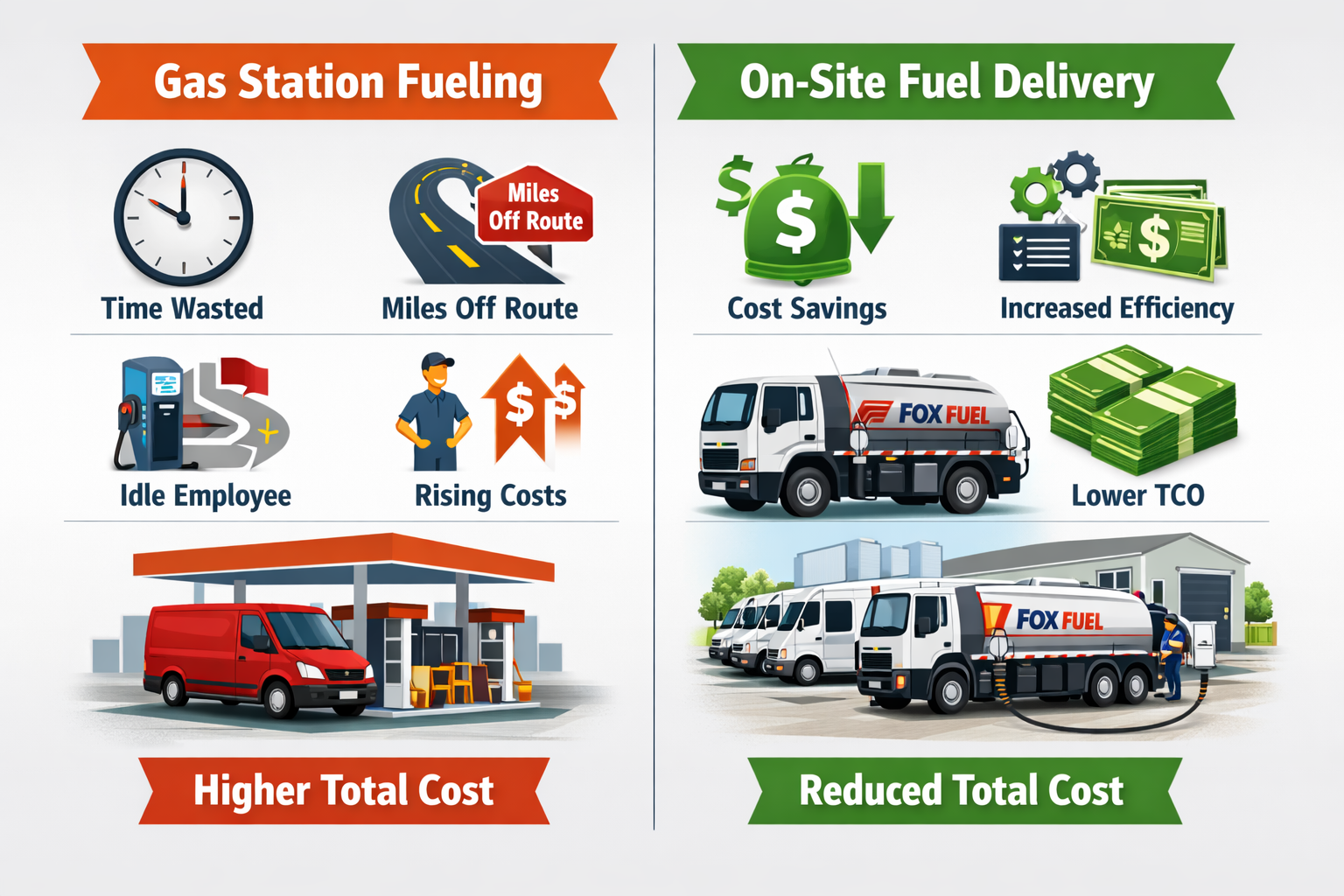
| Factor | Gas Station Fueling | On-Site Fleet Fueling |
|---|---|---|
| Driver Time | Consumed during work hours | Occurs during scheduled downtime |
| Route Miles | Added deviation miles | Zero deviation miles |
| Transaction Records | Multiple receipts, driver-reported | Single delivery ticket per event |
| Per-Vehicle Tracking | Requires driver compliance | Recorded at time of delivery |
| Environment Control | Third-party locations | Your facility |
| Fuel Availability | Subject to station hours and supply | Scheduled to your requirements |
The question is not just price per gallon. When evaluating fueling costs, the retail pump price represents only the direct fuel expense. The operational costs of getting drivers to that pump, managing those transactions, and absorbing the associated exposures are separate line items that often exceed the apparent per-gallon difference.
Fleet Fueling Evaluation Checklist
Use this checklist to assess your current fueling approach:
- Do you know your average driver time per fueling stop?
- Can you calculate your fully-loaded hourly driver cost?
- How many hours per week do your drivers spend fueling?
- What percentage of fuel receipts require follow-up or correction?
- How many staff hours per month go to fuel reconciliation?
- How many deviation miles does your fleet accumulate for fueling?
- Have you had incidents at gas stations in the past 12 months?
- Can you track fuel consumption per vehicle with current records?
When On-Site Fueling Makes Operational Sense
On-site fleet fueling delivers the most value when:
- Your vehicles return to a central location (yard, depot, parking facility)
- You have sufficient fleet size to justify scheduled delivery
- Driver time has measurable cost to your operation
- You need accurate per-vehicle fuel consumption data
- Administrative time spent on fuel reconciliation is significant
- You operate in Pennsylvania or New Jersey (Fox Fuel service area)
Fleets that operate with scattered parking, minimal central facility access, or very low fuel consumption may find retail fueling remains appropriate for their situation.
How Fox Fuel Fleet Fueling Works
Fox Fuel provides on-site diesel and DEF delivery to commercial fleets across Pennsylvania and New Jersey.
Delivery Approach
- Scheduled delivery to your yard, depot, or parking location
- Fueling during overnight hours or scheduled downtime
- Per-vehicle metered delivery with documentation
- Delivery tickets provided for each fueling event
Service Requirements
- Accessible fueling location for delivery truck
- Clear vehicle access during scheduled fueling window
- Minimum volume requirements apply
Fox Fuel operates its own fleet from Pennsylvania, serving commercial customers throughout the PA and NJ region. Emergency dispatch is available 24/7 for established accounts.